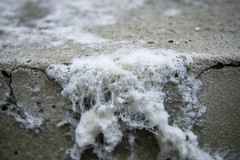
You walk down to the basement, flip on the light, and notice a patch of fluffy white fuzz spreading across the concrete floor or along the base of a wall. Your first thought is probably the worst one: mold. Before you panic, it helps to know that white hairy mold on concrete is one of the most commonly misidentified growths homeowners encounter. Sometimes it really is mold, and sometimes it is something else entirely. Either way, understanding what you are looking at is the first step toward handling it correctly. As a provider of disaster restoration services in Boston, we see this exact scenario play out in basements, garages, and crawl spaces across the region.
The confusion is understandable. Concrete is porous, basements tend to be damp, and anything fuzzy and white triggers an immediate alarm. The good news is that identifying the growth, and the moisture problem behind it, is very doable once you know what to look for.
What That White Fuzzy Growth Actually Is
When people spot white hairy mold on concrete, they are often looking at one of two very different things. The first is actual mold, which is a living organism that feeds on organic material and thrives in moisture. The second is efflorescence, a crystalline mineral deposit that forms when water moves through concrete and leaves salt behind as it evaporates. Both can appear white and fuzzy, which is exactly why they get confused.
There is a simple test that points you in the right direction. Efflorescence is a mineral, so if you rub the growth between your fingers it will feel gritty, like powder or fine crystals, and it will often dissolve when sprayed with water. Mold, on the other hand, is organic. It tends to smear rather than crumble, it may have a musty odor, and it will not dissolve the way salt deposits do. If the growth comes back quickly after you clean it and the smell lingers, you are likely dealing with mold rather than a mineral deposit.
Why Concrete Attracts This Kind of Growth
Concrete may look solid, but it is full of tiny pores that soak up and release moisture constantly. In a climate like ours, where humidity, snowmelt, and heavy rain are facts of life, basements and slab floors are under near-constant moisture pressure. That moisture is the common thread behind both real mold and efflorescence.
Mold needs three things to grow: moisture, a food source, and the right temperature. Concrete itself is not a food source, but dust, dirt, drywall paper, wood framing, cardboard boxes, and other organic debris resting on or near the concrete give mold everything it needs. So when you see white hairy mold on concrete, the fuzz is frequently feeding on the layer of grime or stored materials sitting on the surface rather than the concrete itself. Efflorescence, by contrast, is a direct sign that water is actively migrating through the slab or wall from the outside, carrying dissolved minerals with it.
Either way, the presence of that growth tells you something important: there is more moisture in that space than there should be, and it deserves attention before it leads to bigger problems.
Is White Hairy Mold on Concrete Dangerous?
This is the question we hear most often, and the honest answer is that it depends. Efflorescence is not harmful to your health. It is unsightly and a warning sign of moisture intrusion, but the deposit itself will not make anyone sick. Mold is a different story. Many molds can trigger allergy symptoms, aggravate asthma, and cause respiratory irritation, especially for children, older adults, and anyone with a compromised immune system.
The color of mold is not a reliable indicator of how dangerous it is. White mold is not automatically safer than black or green mold, and many species change color as they mature. What matters more is the size of the affected area, how long it has been growing, and whether it is actively releasing spores into the air you breathe. A small patch you catch early is a very different situation than a wall that has been quietly feeding mold behind stored boxes for a year.
Because of these variables, we generally recommend treating any suspected mold growth as something worth investigating rather than ignoring. If you are unsure whether what you are seeing is harmful, our team is happy to help you understand the difference and the risks involved.
How to Handle It Safely
If you have confirmed the growth is efflorescence, the solution centers on controlling moisture. Improving drainage around the foundation, sealing cracks, running a dehumidifier, and addressing any plumbing leaks will reduce the water movement that creates the deposits. Cleaning the surface alone will not keep it from returning if the underlying moisture remains.
If you suspect genuine mold, resist the urge to scrub it away with bleach and call it done. Disturbing mold can release spores into the air and spread the problem to other areas. For small, clearly defined spots, you can take a few sensible precautions:
- Wear gloves, eye protection, and an N95 mask before touching the area.
- Keep the space ventilated and avoid spreading dust or debris to clean rooms.
- Address the moisture source first, since cleaning alone will not stop regrowth.
- Call a professional if the area is larger than a few square feet, keeps returning, or comes with a strong musty odor.
For anything beyond a minor surface patch, professional assessment is the safer route. Proper mold removal and mold remediation in Boston involves containing the area, removing affected materials, treating the surfaces correctly, and most importantly, fixing the moisture problem so the growth does not come back. That last step is where do-it-yourself efforts most often fall short.
When to Bring in the Professionals
Some situations clearly call for expert help. If the growth covers a large area, keeps coming back after you clean it, appears alongside water damage, or is accompanied by a persistent musty smell throughout the space, it is time to have it evaluated. The same is true if anyone in the home is experiencing unexplained respiratory symptoms that seem to improve when they leave the house.
Hidden moisture is the real challenge with concrete. Water can travel through a slab or foundation wall and feed growth in spots you cannot easily see, behind finished walls, under flooring, or inside crawl spaces. Professionals use moisture meters and experience to find the source rather than just treating the symptom. We serve homeowners throughout Boston and the surrounding communities, and we also provide mold removal and remediation in Dedham and its surrounding towns for families dealing with the same stubborn basement conditions.
The bottom line is that white hairy mold on concrete is worth a closer look, but it does not have to be a crisis. Figure out whether you are dealing with efflorescence or true mold, address the moisture that caused it, and act quickly on anything that spreads or smells. When you are not sure what you are facing or the problem feels bigger than a weekend project, reach out for a professional evaluation. Catching it early almost always means a simpler, less costly fix, and a healthier home for everyone in it.